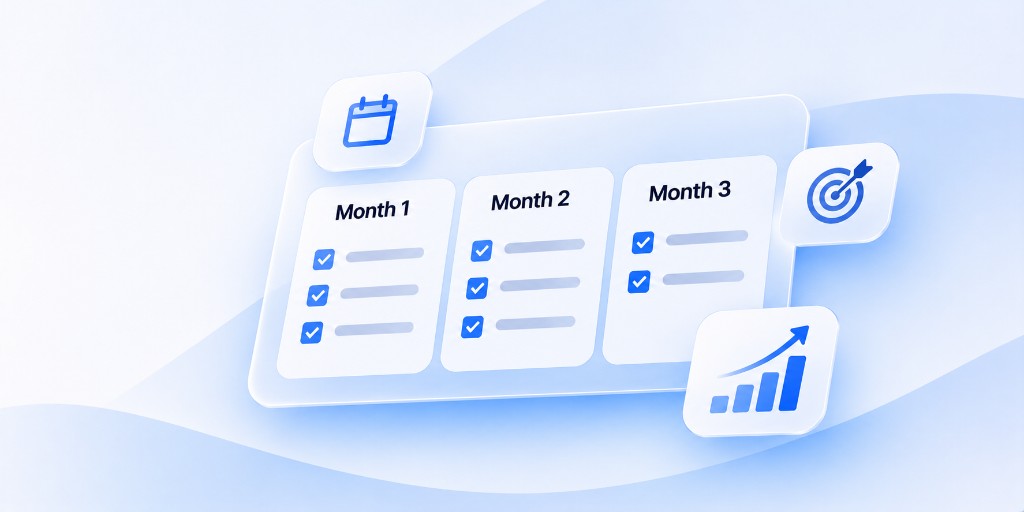
Quick answer: A 90-day marketing plan is a focused, one-quarter plan with a single measurable goal, one target customer, two or three channels and a weekly execution rhythm. For small B2B teams, it beats an annual plan because it is easier to finish, easier to measure, and easy to adjust every 30 days based on real results.
It is planning season. Larger companies are already deep in their 2027 budget cycles; Forrester’s 2027 planning guidance urges B2B marketing leaders to narrow their focus rather than spread budgets thin.
If you are a small team, you do not need a 40-slide annual strategy. You need a clear plan for the next 90 days that you will actually follow. This guide walks you through building one in an afternoon, with a template at the end.
Why a 90-day plan works better than an annual plan for small teams
Annual plans assume you know what will work 12 months from now. Small teams rarely do. A quarterly marketing plan gives you:
- Focus. One goal for 13 weeks is hard to ignore.
- Speed. You can see what is working within a month and change course.
- Accountability. Short timelines make ownership obvious.
- Realistic workload. You plan for the people and hours you actually have.
Think of the year as four 90-day sprints. Q1 2027 is the first one.
Step 1: Set one goal you can measure
Pick one outcome that matters to revenue. Not five. One.
Good examples:
- Book 30 qualified demos by March 31
- Sign 6 new agency clients in Q1
- Grow the email list of ideal-fit prospects from 400 to 1,000
Then work backward. If you need 30 demos and roughly one in five conversations becomes a demo, you need about 150 conversations, or roughly 12 a week. Now you have a weekly target.
Step 2: Choose one ideal customer profile
The fastest way to waste a quarter is targeting “anyone who might buy.” Choose one ideal customer profile (ICP) for the whole 90 days: the industry, company size, role and problem you are solving.
If you do not have one written down, our guide on how to create an ideal customer profile takes about 30 minutes.
Step 3: Pick two or three channels you can sustain
More channels does not mean more results. It usually means thinner effort everywhere. Choose channels where your ICP already spends time and your team can show up consistently for 13 weeks.
| Channel | Best for | Weekly effort for a small team |
|---|---|---|
| Email outreach | Direct pipeline from a defined list | 3–5 hours |
| LinkedIn (founder + company page) | Trust, visibility, warm conversations | 3–4 hours |
| Blog and SEO | Compounding inbound traffic | 4–6 hours per post |
| Instagram or Facebook | Brand awareness, local or visual businesses | 2–4 hours |
| Webinars or events | Education and high-intent leads | 6–10 hours per event |
A common, effective combination for B2B: email outreach + LinkedIn + one blog post a week.
Step 4: Plan three monthly themes
Give each month a job:
- Month 1: Foundation. Clean your list, set up email authentication (see our 2026 sender rules checklist), publish cornerstone content, start outreach at low volume.
- Month 2: Momentum. Increase outreach, repurpose top content, run one offer or event.
- Month 3: Conversion. Focus on follow-ups, case studies and closing conversations started earlier.
Step 5: Build a weekly rhythm
This is where most plans fail. A plan without a weekly rhythm is a wish list. Set a simple repeating week:
- Monday: publish one piece of content; schedule the week’s social posts
- Tuesday to Thursday: outreach batches and follow-ups
- Friday: review numbers for 20 minutes; adjust next week
Step 6: Set a budget and review every 30 days
Your marketing budget for the quarter should cover three things: tools, content production and any paid promotion. Keep a small reserve, around 10–15%, to double down on whatever works in month one.
Every 30 days, ask three questions: What moved the goal? What did not? What do we stop, start or scale?
Free 90-day marketing plan template
Copy this into a doc or spreadsheet and fill in the brackets.
| Section | Your plan |
|---|---|
| Quarter goal | One measurable outcome and a deadline |
| Weekly target | The goal broken into a weekly number |
| Ideal customer | Industry, size, role, main problem |
| Core offer | What you are inviting them to: demo, audit, trial |
| Channels (max 3) | Channel 1, channel 2, channel 3 |
| Month 1 theme | Foundation: key actions |
| Month 2 theme | Momentum: key actions |
| Month 3 theme | Conversion: key actions |
| Weekly rhythm | Who does what, on which day |
| Budget | Tools, content, paid, reserve |
| Success metrics | Leading: replies, conversations. Lagging: demos, deals |
| Review dates | Day 30, day 60, day 90 |
Example: a 5-person digital agency
- Goal: Sign 4 new retainer clients by March 31, 2027
- ICP: Owner-led dental and medical aesthetics clinics in Ontario, 5–30 staff
- Offer: Free 20-minute local visibility audit
- Channels: Email outreach, LinkedIn, one blog post a week
- Weekly target: 60 personalized emails, 3 LinkedIn posts, 4 audit calls
Common mistakes to avoid
- Setting goals you cannot measure (“increase awareness”)
- Adding a new channel mid-quarter instead of fixing the current ones
- Planning content without planning distribution
- Skipping the 30-day review
How RevWyze helps
RevWyze helps small teams turn a plan into a running quarter: build your ideal customer profile from a short chat, create campaign content in advance, and schedule it to email, LinkedIn and Meta from one place. In the marketing planner, Wyzer can draft that plan with you, and your team reviews everything before it goes live.
Frequently asked questions
What is a 90-day marketing plan?
A 90-day marketing plan is a one-quarter plan built around one measurable goal, one target customer, a few channels and a weekly routine. It is shorter and more flexible than an annual plan.
What should a 2027 marketing plan include?
At minimum: a measurable goal, your ideal customer profile, your core offer, two or three channels, monthly themes, a weekly rhythm, a budget and review dates.
How do I create a marketing plan for a small business?
Start with one revenue goal, define who you are selling to, pick channels you can maintain weekly, and review results every 30 days. Keep the plan to one page.
How much should a small B2B company spend on marketing?
It varies widely by industry and growth stage. Start from your goal and the cost of the activities needed to reach it, and keep 10–15% in reserve to scale what works.
Is a quarterly marketing plan better than an annual plan?
For most small teams, yes. A quarterly plan is easier to execute and measure, and it lets you adjust quickly. Many teams keep a light annual direction and plan in 90-day sprints.