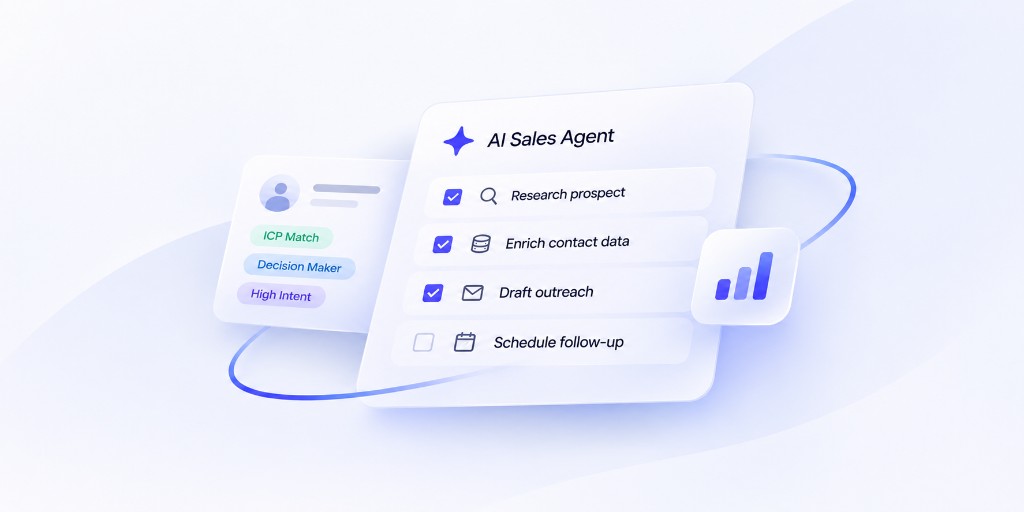
Quick answer: Agentic AI for sales is software that completes multi-step sales tasks toward a goal, such as researching a prospect, enriching contact data, drafting outreach and logging next steps, with limited supervision. The best setups keep humans in control of approvals, sending and relationship decisions, so reps get speed without losing judgment or brand voice.
If you work in sales or marketing, “agentic AI” has gone from a buzzword to a line item on your 2027 plan. The question is no longer whether AI can help your team. It is which parts of the job an AI agent should own, and which parts should never leave a human’s hands.
This guide breaks that down in plain language, with a simple model you can start using this week.
Why is everyone talking about agentic AI right now?
Because buyers have stopped asking what AI is and started asking for AI that does the work. US searches for “agentic ai” now average around 110,000 a month, up 39% year over year, while broad curiosity searches like “ai for marketing” have dropped 38% (AI Search Demand Report 2026).
Sales is moving fastest. Searches for AI agents and tools for sales teams grew more than 1,200% year over year in the July to September 2026 period, the fastest growth of any profession tracked (Gravity AI Agent Demand Index).
The shift makes sense. Reps spend a large share of their week on research, data entry and writing first drafts. Those are exactly the tasks agents are built for.
What is agentic AI, and how is it different from a chatbot?
Agentic AI is AI that works toward a goal across several steps, deciding what to do next, instead of answering a single prompt.
| Chatbot or generative AI | Agentic AI | |
|---|---|---|
| How it works | Responds to one prompt at a time | Plans and completes a sequence of steps |
| Example | “Write a cold email to a dental clinic” | “Find 50 dental clinics in Ontario that match our ICP, enrich the owners’ contacts, and draft a personalized first email for each” |
| Who drives | You, every step | The agent, with you approving key moments |
| Best for | One-off writing and ideas | Repeatable workflows |
In short, generative AI writes. Agentic AI works.
What do AI agents do well in a sales workflow?
AI agents are strongest on tasks that are repetitive, research-heavy and follow clear rules. For most small sales and marketing teams, that means:
- Prospect research. Pulling company details, recent news, team size and tech stack before outreach.
- Lead enrichment. Filling in missing emails, titles and company data, and flagging records that do not match your ideal customer profile. (See our guide to lead enrichment.)
- Lead qualification. Scoring leads against your ideal customer profile so reps start with the best fits.
- First-draft outreach. Writing personalized emails, LinkedIn messages and follow-ups based on what the research found.
- Meeting notes and follow-ups. Turning call recordings into summaries, action items and a draft follow-up email.
- Inbox triage. Sorting replies into interested, not now, wrong person and unsubscribe, so nothing slips.
Each of these saves time without asking the agent to make a judgment call that could damage a relationship.
What should stay human?
Anything that carries reputation, relationship or legal risk should stay with a person. Specifically:
- Approving messages before they send. An agent can draft 100 emails in minutes. One wrong name, claim or tone can cost you a deal or a domain’s reputation.
- Brand voice and positioning. AI can follow guidelines, but a human should decide what you stand for.
- Pricing, negotiation and custom terms. These need context an agent does not have.
- Relationship moments. Discovery calls, objection handling and the message that notices what a team just went through belong to people.
- Compliance decisions. Who you can contact, how often and with what opt-out language are your responsibility, not the software’s.
Human in the loop: the model that actually works
Human-in-the-loop AI means the agent does the work and a person approves the decisions that matter. It is not a limitation. It is how you get speed and trust at the same time.
Here is what a day can look like for a rep working this way:
- 8:30 a.m. The agent has already researched 40 new leads overnight and ranked them by fit.
- 9:00 a.m. The rep reviews 25 drafted first-touch emails in a queue, edits three, rejects two and approves the rest.
- 11:00 a.m. A discovery call is recorded. Within minutes, the rep has a summary, action items and a drafted follow-up.
- 2:00 p.m. Replies are sorted. The rep handles the five interested prospects personally.
- 4:00 p.m. The rep spends the last hour on the conversations that need a human: negotiation, relationship building, strategy.
The rep touched every message that went out, but spent most of the day selling instead of typing.
How to start with agentic AI this week
You do not need a full AI strategy. You need one workflow running well.
- Pick your most repetitive task. For most teams, it is prospect research or first-draft outreach.
- Write down your ideal customer profile. Agents are only as good as the targeting you give them.
- Set your approval points. Decide which steps the agent can finish alone and which need sign-off. Start with “everything outbound gets approved.”
- Check your sending setup. Make sure your domain meets current Gmail and Outlook rules before you scale. Our 2026 sender rules checklist covers this.
- Measure one number for 30 days. Hours saved, reply rate or meetings booked. Expand only once it works.
Common mistakes to avoid
- Letting agents send unreviewed. Volume without review is how domains get flagged.
- Feeding agents bad data. Unverified lists produce confident, wrong outreach.
- Automating a broken process. If your messaging does not work manually, an agent will just fail faster.
- Treating AI as a replacement for reps. The teams getting results use agents to give reps more selling time, not fewer reps.
How RevWyze approaches agentic AI
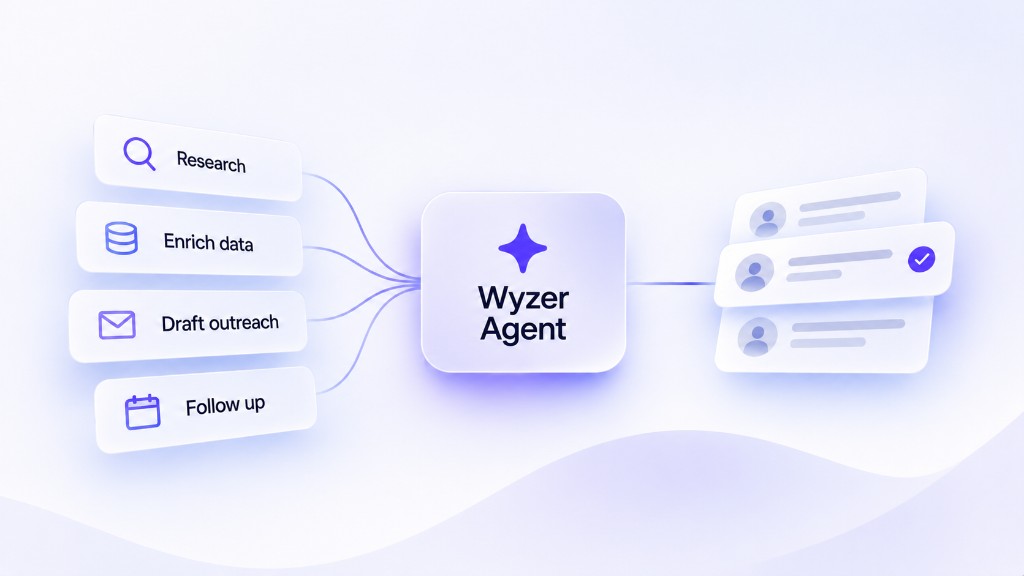
RevWyze is built on the human-in-the-loop model. Wyzer, our AI agent layer, researches and enriches leads, builds your ideal customer profile from a short chat, and drafts campaigns across email and social. Your team reviews and approves before anything goes out. You stay in control; the grind is handled.
Frequently asked questions
What is agentic AI in sales?
Agentic AI in sales is AI that completes multi-step sales tasks, like researching prospects, enriching data and drafting outreach, toward a goal with limited supervision. It differs from a chatbot because it plans and carries out a sequence of steps rather than answering a single prompt.
Will AI agents replace sales reps?
No. AI agents take over research, data entry and first drafts. Relationship building, discovery, negotiation and judgment still need people. Most teams use agents to give reps more time for selling.
What is human-in-the-loop AI?
Human-in-the-loop AI is a setup where the AI does the work but a person reviews and approves key decisions, such as sending a message or updating a deal. It reduces errors and protects brand and domain reputation.
What sales tasks should I automate first?
Start with prospect research, lead enrichment and first-draft outreach. They are repetitive, time-consuming and low-risk when a human approves the final output.
Is agentic AI safe for cold outreach?
It can be, if every outbound message is reviewed, your data is verified and your domain meets Gmail and Outlook sender requirements. Problems usually come from unreviewed, high-volume sending.